Finding the right accommodation for foreign workers is a critical decision for employers. The choice between a licensed foreign worker hostel and non-compliant hostel is often based on rental cost. However, the lowest monthly rent does not always mean the lowest overall cost. This post explores the differences, hidden costs, and benefits of each option to help recruitment and self-employed employers make informed decisions.
What are Licensed Foreign Worker Hostel and Non-compliant Hostel?
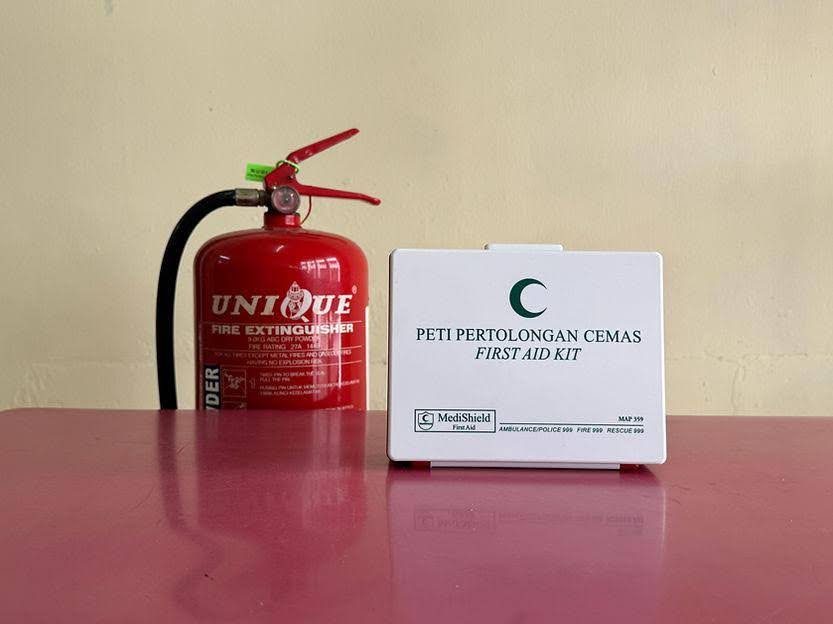
A compliant hostel, by contrast, is built to meet Malaysia’s legal minimum standards under Act 446 including a valid Certificate of Accommodation (Perakuan Penginapan), prescribed space per worker, sanitation ratios, fire safety provisions, and gender separation. JTKSM defines this framework specifically to ensure housing and amenities are safe, hygienic, and legally recognized but not just affordable.
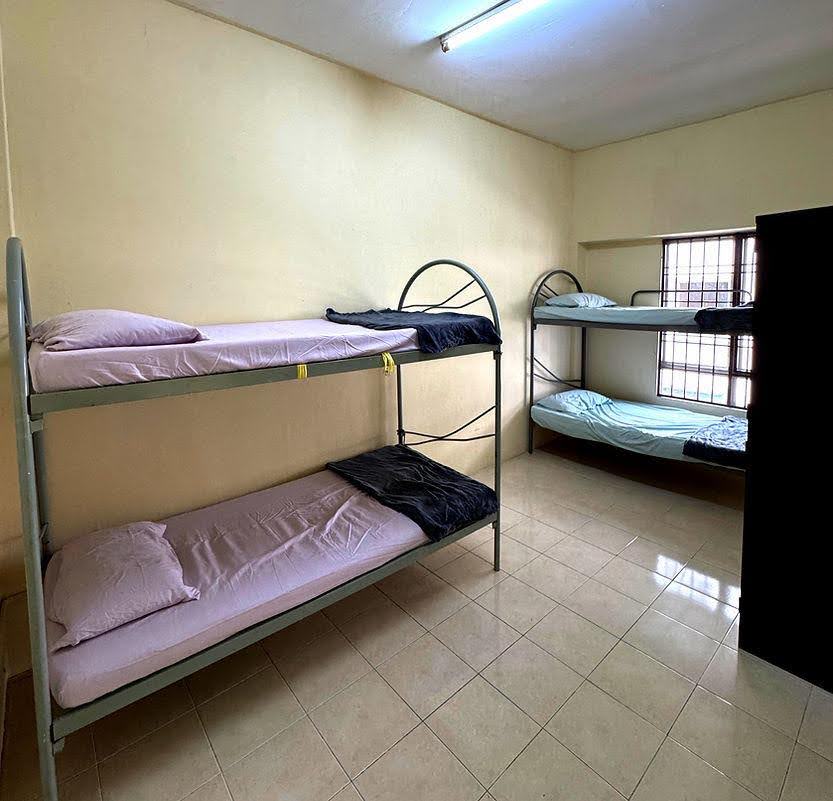
A non-compliant foreign worker hostel is typically defined by one priority: minimizing monthly rent or setup cost. This often means converted shop lots, warehouses, or shared units with no Certificate of Accommodation, minimal space per worker, and no formal safety or sanitation planning.
The core difference isn’t quality of finishing, it’s whether the hostel exists inside or outside the legal framework that JTKSM enforces.
What are the compliance requirements for Compliant Foreign Worker Hostel in Malaysia?
Act 446 (officially the Employees’ Minimum Standards of Housing, Accommodations and AmenAct 446ities Act 1990) applies to Peninsular Malaysia and the Federal Territory of Labuan. Key requirements employers should know:
- Certificate of Accommodation (Perakuan Penginapan):
Required before housing workers; applications are submitted online via the official portal (akta446.mohr.gov.my).
- Accommodation and Centralized Accommodation Regulations 2020:
Sets out physical standards, including space allocation, sanitation ratios, ventilation, and facility requirements for both employer-built housing and third-party centralized labour quarters (CLQ).
- Accommodation to be certified with Certificate for Accommodation:
The laws of Malaysia Act 446 stated that if employers fail to obtain accommodation certificates, upon conviction, a fine not exceeding RM50,000. For any violation not expressly penalized (e.g., Accommodation must meet minimum standards), a fine not exceeding RM50,000 + an additional RM1,000 per day for continued violations.
All of these regulations are published and downloadable directly from JTKSM’s official Acts & Guidelines page.
The Hidden Costs of Non-compliant Hostels
Non-compliant hostels often delay costs to a later time, which usually results in significantly higher expenses:
- Fines and prosecution:
Under Section 24D(1), non-compliance can lead to fines that up to RM50,000, and in some cases imprisonment for centralized accommodation providers, under Act 446 and its subsidiary regulations.
- Renovate and relocation:
A failed JTKSM inspection may require costly, rushed renovate or complete relocation. Under the tight compliance deadlines, at a much higher cost than planned construction.
- Business Disruption:
If accommodation is found non-compliant, authorities may require rectification, temporary relocation, or other corrective measures, which can disrupt production.
- Complaints and investigations:
Worker will complaints about overcrowding or poor sanitation, which can caused prompt JTKSM inspections and, where relevant, further action by other authorities, hence to damage the reputation. There is a case which a company remains a widely cited example of how substandard housing conditions can escalate into major public health, legal, and reputational crises for employers.
Value return of Compliant Hostels
Compliant hostels cost more upfront, but the return shows up across several dimensions:
- Retention
Safe, adequate housing may help supports worker wellbeing and reduces turnover-driven recruitment costs.
- Fewer accidents and health incidents
Meeting Act 446’s sanitation, ventilation, and space standards reduces the kind of overcrowding-related health risks documented in past enforcement cases.
- Lower enforcement risk
A valid, well-maintained Certificate of Accommodation removes exposure to fines under Section 24D(1) (up to RM50,000) and the risk of forced evacuation if certification is revoked.
- Better productivity
Rested, stable workers with secure housing are generally more consistent performers.
Table: Non-compliant Hostels vs Compliant Hostel — Short-Term vs Long-Term Risk Cost
| Factor | Non-compliant Hostels/ Scattered housing | Compliant Hostel (Act 446) |
| Upfront cost | Low as employer only pay for usual rentals. | Employer need to allocate higher budget to setup the hostel properly and licensing cost. |
| Legal status | No/Invalid Certificate of Accommodation | Valid Perakuan Penginapan |
| Legal exposure | Fines up to RM50,000+ imprisonment risk (s.24D) | Minimal, if standards maintained |
| Business continuity | Risk of forced evacuation | Stable, audit-ready |
| Long-term cost trend | Recurring fines + emergency retrofits | Predictable, front-loaded investment |
Practical decision framework for Employers
Use these self-assessment questions to determine which path makes sense for your organization:
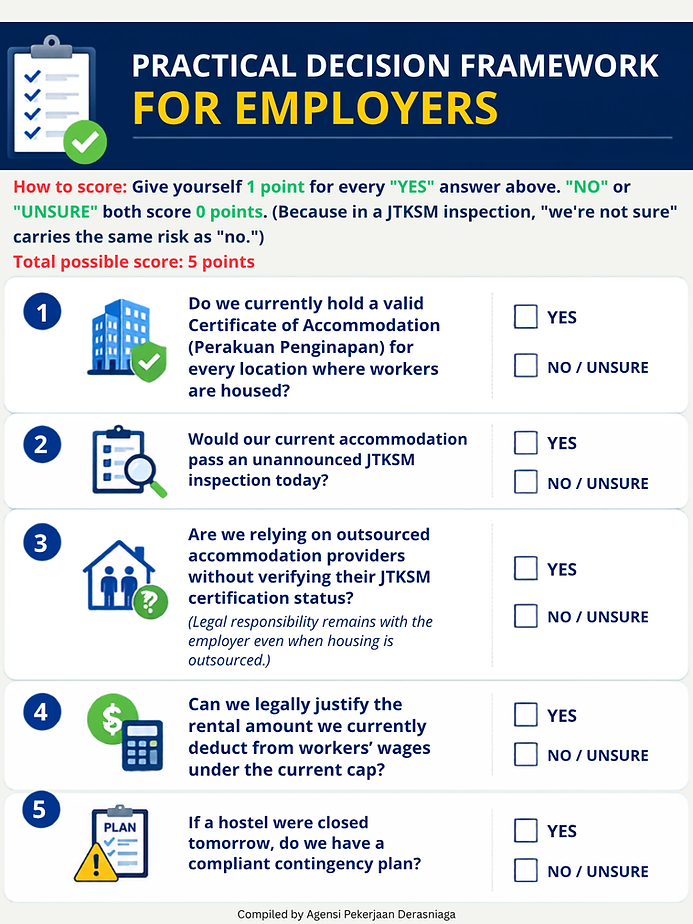
If you get the following scores:
🟢 Safe Zone: 4–5 points
Your accommodation management appears to be on the right track. Continue maintaining documentation, conduct regular internal audits, and stay updated with regulatory changes.
Next step:
Don’t treat this as “done.” Certificates, rental caps, and provider certifications need periodic re-verification. You can schedule a review every 6–12 months, or whenever regulations like P.U.(A) 49/2026 are updated.
🟡 Needs Improvement: 2–3 points
You’re meeting some important requirements, but there are gaps that could become compliance risks during a JTKSM inspection. Address the missing areas as soon as possible.
Next step:
Prioritize the specific questions you answered “no” or “unsure” to. Request certification proof directly from any outsourced accommodation provider, and cross-check your wage deduction amounts against the current legal cap (RM100–RM150) rather than assuming your provider has already adjusted for it.
🔴 Danger Zone: 0–1 point
If you scored here, your organisation may face significant compliance risks, including enforcement actions, corrective orders, penalties, or operational disruptions. Immediate action is strongly recommended.
Next step:
Treat this as urgent. Apply for or renew your accommodation certificate through the akta446.mohr.gov.my portal and schedule an internal compliance check with JTKSM before processing your application. Regardless of whether the outsourcing service provider is at fault, the penalties under Section 24D apply, and legal liability always rests with the employer. Please schedule with a meeting with Derasniaga group to discuss how we can assist in providing proper and compliant hostel for your workers.
( Note: This self-assessment is a general risk indicator, not a legal compliance certification. Employers with any "no" or "unsure" answer should still verify their status directly through JTKSM or a qualified compliance advisor. )
Conclusion
Employer tend to choose the easiest option , which only appear economical by just paying the monthly rent for nearby accomodation. It may appear cheaper now but the real questions is whether it will be more expensive in long run? Non-compliant costs, fines, forced evictions , shutdowns, staff turnover, failed audits once factored it may cost more in the long run. Employers have to weigh the real costs to ensure provide legal protection and sustainable business continuity.
( Note: All regulatory references in this article are sourced from the official Department of Labour Peninsular Malaysia (JTKSM) website (jtksm.mohr.gov.my) and the official Act 446 application portal (akta446.mohr.gov.my). Employers should verify current requirements directly via JTKSM before making compliance decisions, as regulations are subject to periodic amendment. )
References
- JTKSM | Employees’ Housing, Accommodations and Amenities
- JTKSM | FAQ – Employees’ Housing, Accommodation and Amenities
- JTKSM – Buku Panduan Penginapan Pekerja
- Osadi Malaysia | Malaysia Updates Act 446 Accommodation Rental Cap to RM150
- JTKSM – Perumahan, Penginapan dan Kemudahan Pekerja
- JTKSM – Acts & Guidelines
- Act 446 – EMPLOYEES’ MINIMUM STANDARDS OF HOUSING, ACCOMMODATIONS AND AMENITIES ACT 1990
- JTKSM – Buku Panduan Penginapan Pekerja
- Sevenpillars Institute – Labor Exploitation: Case Study of Top Glove
- Sources: P.U.(A) 49/2026 rental cap amendment; JTKSM Act 446 enforcement framework